
New Book and Getting Things Done
A new book of my text scores is available now, but I'm not sure what I've accomplished this year.

Contents
The Part About Composing
The Part About Music
The Part About Sawyer Editions
The Part About Books
The Part About Movies
The Part About Racing
Conclusion Corner
I want to start this one off by saying thank you to everybody who read and reached out about the last entry, especially people saying that they did, in fact, read all of this: your feedback is extremely affirming and valued beyond words. This is only the third entry in this, and again, I’m only committing myself to a year (and beyond that it’s anybody’s guess), but I am finding a lot of joy in doing this. I feel like a lot of people try starting journals and they realize that the journals are extremely self-conscious and end up talking about the fact that they’re writing a journal; or, overthinking the fact that they’re putting their thoughts down brings out a sort of weird self-conscious or stilted voice. My old journals are rife with that and I’m sure this blog is part of that too... at least I’m not doing this by hand; I can think and type fast enough that my fingers can keep up with my brain way better than my hand while writing… which may certainly have something to do with why these are so rambling and long winded. That, and my love of chains of superordinate clauses… but again, the fact that anybody would want to go with me on this is deeply appreciated and affirming. Thank you again!
Upcoming things
03/17 – Columbia, MO
03/18 – Indianapolis
03/19-20 – BGSU
03/21-23 – Bard College
03/24 – Vassar College
03/25 – Concord, NH
03/26 – Portland, ME
03/27 – Burlington, VT
03/28 – Somewhere in the middle of New England doing something.
03/29 – Providence, RD
03/30 – Boston, MA
03/31 – Conn College
04/01 – NYC
04/02 – NYC
04/03 – Jersey City
04/04 – Philadelphia
04/05 – Baltimore
04/06 – Richmond
04/07 – Norfolk
04/08 – Charlotte
04/09 – Columbia, SC
04/10 – Driving my ass all the way to Tulsa, Oklahoma
04/11 – One Aux Festival of Music, Sound, and Noise
04/12 – One Aux Festival of Music, Sound, and Noise
New Book: Sunday Mass
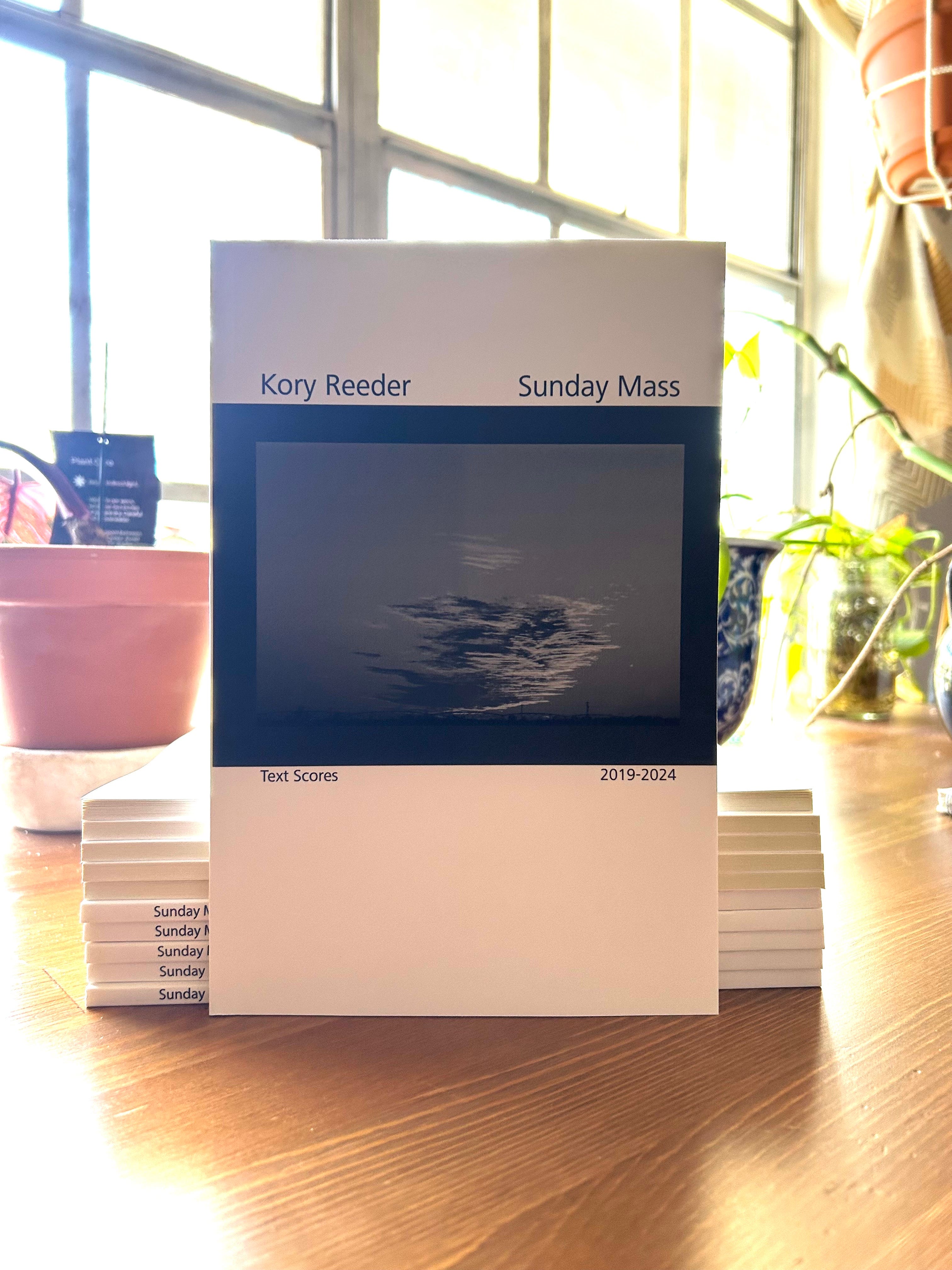
I am very excited and nervous to share this collection of text scores, out now and available on my Bandcamp page. I’ve been wanting to do this for a long, long time and I finally sat down and really dug into this project. I love how this thing turned out, how it looks, the process of putting it together, and I’m very stoked to have this thing out and in the world.
This collection of text scores is a survey and a re-formatting of my work in prose and text scoring between 2019 and 2024. While not comprehensive, several of these pieces are from my Grid Series and a few have never been presented publicly or privately. In most cases, my commitment to harmony and a specific harmonic grammar meant that these scores were presented with attached pitch material. However, the text always came first and, in this volume, these works present themselves as poems, elegies, fragments of memory, and private addresses, but they are, of course, scores.
I find that an overwhelming number of scores in the prose-scoring “tradition,” even the more poetic pieces in the corpus, tend to be written in the imperative mood and give commands or describe processes: “play a note.” It has been a long-term goal of mine to find new ways of making text scores—and one that seems to be unending. Still, the scores in this book are an attempt expand what a musical instruction can be and how language and poetry can be explored as the primary impetus for musical expression.
I too use the imperative mood in some of these scores, but these pieces rarely dictate pitches or rhythms as much as they define presence. A performer may be asked to wait, to listen, to sound a faint tone, to hold a vowel, to measure silence, to affirm another’s existence without expectation of return. The concerto becomes an ethics of attention; the ensemble becomes a congregation; the soloist may play or may simply be.
The prose sections can be trusted as performative structures that allow interiority and self-consciousness into the performance. Some pieces unfold in dense prose, staging and circling questions of ego, distance, affirmation, and collapse. Yet even in the most diaristic passages, these texts do not confess so much as they frame: they construct a context in which attention becomes the primary instrument. Each page establishes a condition, and the most interior reflections operate as rehearsals of identity in public, maps of how to inhabit a room, and blueprints for listening when nothing seems to happen.
At its core, this is a cycle of scores about relation: between sounds, between bodies, between selves, and between language and sound. Silence is never empty here. It is patient, charged, and waiting, and it carries with it the full weight of attention: an affirmation that in sounding, and in listening, and in reading, we are here. This collection is not the end of this journey, but by presenting these pieces in this format, organized like a book of poetry, it is my hope that the exploration continues and that some folks may find resonance with these ideas as well.
Several scores from this collection will not be made available anywhere else - digital or otherwise.
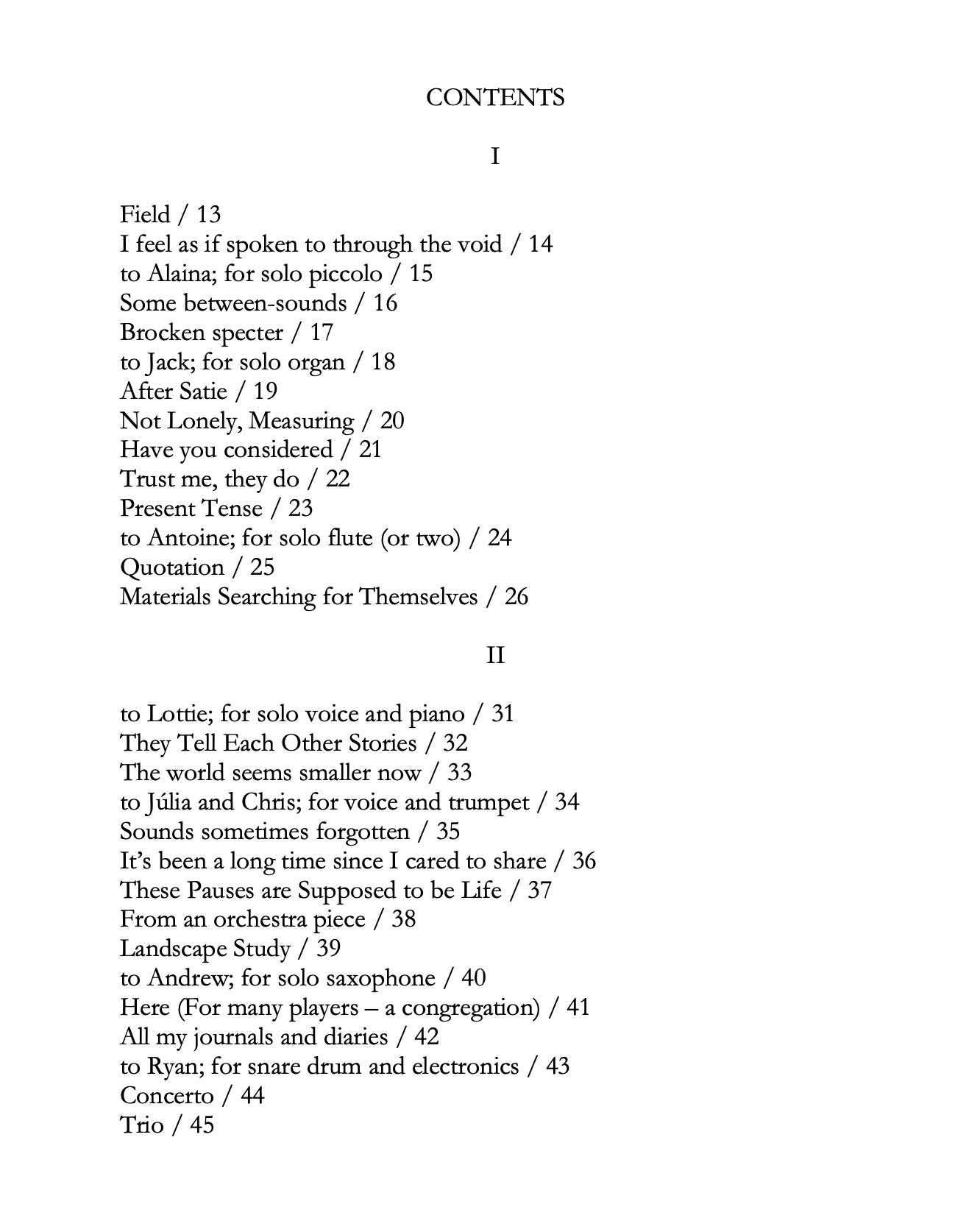
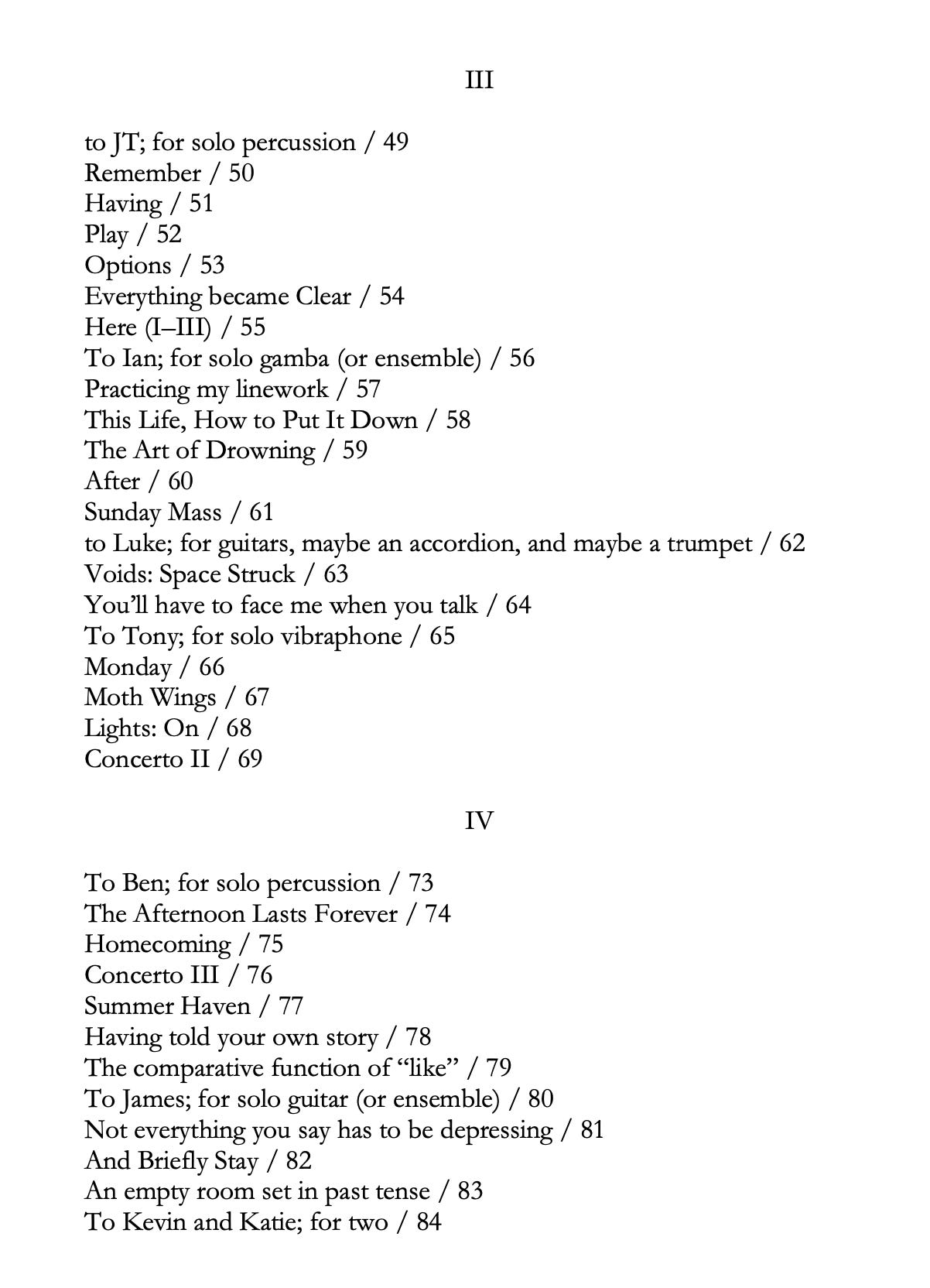
The Part About Composing
Getting Things Done: On the Self-conscious Size of My Portfolio
This last month has been interesting in a number of ways. I haven’t played a show since I got back from tour and I’ll be leaving for a month-long tour only a few days after this is published, which means the next entry will almost entirely be written from the road: a conversation for next time. I don’t know where this month has gone. I don’t know where the time has gone and it’s hard to both qualify and quantify what I’ve gotten up to and what I’ve worked on or the progress that has been made on a ton of projects.
It’s easy to fall into a trap of confusing who you are with who you think you are and who the world thinks you are and who you think the world thinks you are. These are all different people and only one of them is your lived experience. Still, all the other ones can scream in your head and can push you in uncomfortable directions; they can push you into head-spaces that aren’t necessarily productive for anybody. For me, this manifests in a sense of obligation for productivity. Not necessarily the capitalist sense of hustle-culture, etc., but of quantity of things done (which, admittedly, might be the same thing).
I have been described elsewhere--in a print and people just telling me--that I am “prolific,” or I am a “prolific composer,” etc. It’s true, I do have a large catalog of work that I’m quite proud of: I really like what I’ve done and I’m extremely happy that I’ve had the privilege of getting to do a lot of different things in my life. I’m also extremely happy to be busy and to constantly have a ton of irons in the fire. I joke that just because I have a lot of shit out there doesn’t mean any of it is particularly good, but in all seriousness, I am very happy with the work I’ve done, and I am very lucky to have had the opportunities to make this work happen. Still, this image of being “prolific” is not necessarily who I am: it’s a projection, or maybe a biproduct of a time in a place.
I felt like I was really behind when I started taking this music seriously. Darleen Mitchell taught me to explore the possibilities of what music could be and Tony Donofrio taught me how to get those ideas down, but Kearney didn’t have a scene for this music outside of UNK, and I wasn’t at all aware of the ways you navigate getting your work out there or getting work in the first place (let alone what to do with it after). When I landed at BGSU for my Master’s, I had never had a composition performed outside of the University of Nebraska at Kearney; I had never submitted to a call for scores—I don’t even think I really know what they were. But I made two friends, Nathaniel Hearing and Adam Kennaugh who had both done, well, anything outside of the halls of their undergrad. At the same time, I had just spent the last 5 years touring pretty incessantly in a hardcore band and I’d been involved in the DIY scene in Nebraska since I was 13. That was pretty much all I needed in order to know that it was time to hit it as hard as I can.
When I went to grad school, I already had a fairly clear sense of my aesthetic interests. I had long been drawn to experimental music and I had a few (unwieldy) pieces in my pocket. I felt that I had a good intuitive grasp of harmony, even though I was never especially interested in studying music theory in a formal or technical way. My work often shares a similar sonic character, but that consistency does not mean the process is static. I am constantly thinking about new and fun ways to access that sound and find new approaches to making my music, and new ways of engaging both with the music itself and with the people I collaborate with. Because of that, I wanted my research to help me articulate these instincts more clearly. I hoped it would give me a theory of history and a vocabulary to express the ideas that shape how I think about making music. At the same time, I wanted the work to situate those ideas within a broader artistic context—to think about the particular historical moment we are in and what possibilities it opens up, not only for my own work but also for what others might do. I wanted to do this in abundance; I wanted to do as much as I possibly could. At the same time, my first job was in a corn field: I’m not afraid to get my hands dirty.
I spent the two years at Bowling Green writing the best handful of pieces I could: pieces that I could submit to stuff, pieces I could play, pieces I could use for portfolios for residencies, awards, PhD applications, albums, etc. To this day I still haven’t won an award, but I got a lot of shit done between 2016 and 2018. I spent 2 years grinding: working from 8AM until I couldn’t (I also drank a shitload). Marilyn Shrude told me once that an MM at BGSU is like “attending a monastery: you show up and there’s nothing to do but work, so all you do is work for 2 years and then hopefully you leave ready for the next thing.” Chris Dietz called me “gritty” – we’ll get back to that. Mikel Keuhn pushed me to think deeper about how I made my pieces, and Elainie Lillios pushed me to be better organized and to think about the community around me and how our professionalism radiates between eachother. So, by the time I landed in Texas for the PhD, I finally felt like I had both the skills and the know-how to really hit it as hard as I could.
I went to UNT for my PhD, not to study with anyone in particular, but for the time, space, and resources to make as much music as I possibly could. UNT is the largest public music school in the country, with approximately 1500 music students and I was fortunate to get funding and an assistantship with keys to the Merrill Ellis Intermedia Theater, which became something of a sandbox or playground or personal studio (not to blend metaphors). Here, I was able to write, record, perform, and engage with a ton of music: exactly the music I had been wanting to make since I was in Kearney. Not only that, but by this point I had learned enough about the game and hustle of the New Music World that I felt a stable access to both the traditional new music world and the experimental and DIY music worlds (or at least enough to know how to navigate it in ways that worked for me). I was able to do and write a lot of things all at once and work on a lot of things all at once and get immediate results and feedback. When you do that for several years, things just add up.
The last two-years-or-so especially, but really since 2021, I look at my catalog of works and sometimes I get really concerned and stressed out. Deep down, I know I would rather write one piece that’s amazing than a ton of bad pieces, but inside it’s all noise. “Oh, I haven’t finished a piece this year” or worse: “I haven’t finished enough pieces this year” or even worse yet: “I’m not writing fast enough.” I’m not writing enough. I’m not getting enough commissions. I’m not being asked to do enough things. I’m not releasing enough. I find myself trembling under the anxiety of my own influence. Why haven’t I finished a piece yet? Why didn’t I write today? Why did I spend so much time on emails? Why did I spend so much time writing that fucking blog entry? Where has the time gone? You wasted it and now the day is done and you’re too tired to compose but you need to get something done so you drift some breezing piece of shit that you’re just going to throw away tomorrow anyway but you did it because you needed to do something because you wasted all your time eating when you should have been writing but you can’t write when you’re designing Sawyer stuff and you didn’t get that prize or that residency because your work sucks because you’re not writing because you’re spending too much time touring and booking tours and you really should hire a manager but you can’t because you can’t afford one because you aren’t getting enough commissions because you aren’t writing enough and because you’re not writing enough you’re not living up to anyone’s expectations because people look at your work and think “damn he’s really slippin’ he hasn’t done shit this year” which is bullshit because you did a ton of stuff this year but they did more but you have nothing to show for it because you didn’t add it to the spreadsheet because you got distracted because you needed to eat food and take the dogs out but you would have had 5 pieces finished by now you would have had 5 more performances by now you would have had 5 more better ideas by now…
While those emotions—and that anxiety—are real, that person, that image, the projection of “Kory the Prolific Composer” is not real. It’s something that I feel I should be and it’s someone I don’t particularly enjoy talking to in my head. It’s a self-prescribed persona of someone that I feel I ought to be, but he brings with him enough baggage that it can sometimes be paralyzing. I’m smart enough to know that at the end of the day nobody really cares all that much about anything I do. That’s not some self-deprecating dig: there’s way more important shit going on in the world right now. It’s possible, even, that this person in my head is just a projection in a different sense: a coping mechanism. A way for me to freak out without it being about the real, tangible, probably apocalyptic doom we are barreling toward; an inward manifestation of the existential dread that is 21st century Americana. A question for a therapist; a conversation for a different time.
Through all that, I never want lose is that sense of myself as a joyfully disciplined artist: maybe not somebody who is writing all the time, somebody who is trying all the time. Somebody who is always working with several irons in the fire, not out of a capitalistic sense of the hustle, but out of a sense of joy, a sense of exploration, a sense of yearning to create and find new and interesting ways of thinking about art and the world around me. This does take discipline, but it is not a results-based process: it doesn’t necessarily mean shit gets finished, and that doesn’t necessarily mean that my catalogue of work gets bigger, but it can mean that I am channeling that energy into a different but equally productive direction. Things like research, booking tours, working on Sawyer Editions, etc. that’s all the great stuff that makes the artistic lifestyle worth living. That means being disciplined enough to read, to listen, to go to concerts, to use joy as an act of resistance and to see creativity beyond the work I do for myself. The self-image that I aspire to—more than quantity itself—is just the drive to create and be creative. It’s on my website: In the end, I think my work and artistic drive can be summarized as having been built on the fact that I just want to do cool stuff with my friends- all the time. That is affirmation, and I think we need that right now.
Example: the book of text scores seen above.
Admittedly, this multiplicity could take away from certain things. When I’m spending all day sending emails and trying to book a tour, it’s hard to compose. It’s hard for me to get into a headspace for composing in general these days and sometimes the amount of stuff I have to do for Sawyer Editions just adds up. Not to mention the fact that the world in general can just give me such paralyzing anxiety that makes it hard to work on any of them... Sometimes I’m reminded of the Raymond Carver poem “One More” that brought me to tears the first time I read it:
“…What
can be said for a man who chooses to blab on the phone
all day, or else write stupid letters
while he lets his poems go unattended and uncared for, abandoned-
or worse, unattempted…”
So, through all the anxiety and distractions, the emails and the awards I’ll never win, I hope I never lose that drive for creating, for being present, for living through my work in whatever form it comes, even if it doesn’t make it to the spreadsheet, even if it isn’t quantifiable. I didn’t get a PhD in music for a job—that was not and never will be a pragmatic decision. The pragmatic motivation behind the PhD was to create and to build a foundation for this artistic lifestyle: to realize projects and to explore and to learn. Now that I’m no longer a student but just a guy in the world, I haven’t lost that creative drive, I just have a lot more to do these days and I’m finding new ways of expressing that creativity. It still brings me just as much joy as when I started writing shitty little punk songs when I was a pre-teen and that is something I will always attend to and always care for: that is the projection I hope to always keep focused on.
But I did Finish a Piece for Pedal Steel
Written especially for Matt Sargent
A bunch of things went into writing this piece and it’s hard to narrow down an exact starting point (outside of the fact that Matt asked me for this piece in the first place).
I work door (and sometimes bartend and sometimes bar-back) at a divey Americana somewhat-gothy-border-like-country bar in Denton, TX. I’m also a big fan of the Golden Age country music (Third and Fourth gen. from the 50s to the 70s especially). I grew up with that music around me on my Mom’s side of the family, and I’m around it a lot more than a lot of people may realize. The sound of the pedal steel it’s something I’m intimately familiar with and it’s a sound that I absolutely love; one of the best shows I’ve ever seen was a solo set of Susan Alcorn, which also demonstrated just how far this instrument can go and how under-explored it really is. I have no illusions that my contribution to this repertoire is but a blip —and is nothing more than a blip— but it’s a sound I absolutely adore and this piece was one of the hardest I’ve ever written in terms of what it actually took for me to write this piece.
I borrowed a pedal steel from Andy Rogers and spent months teaching myself how to play it, trying to get some sense of what this piece could be in an idiomatic sense. I’ve looked at a number of scores written for this instrument and several of them feel pretty obviously written at a piano or written without the instrument in-hand and that’s not what I wanted to do. I wanted this piece to be idiomatic and untransferable.
At the same time, a few things have entered my life that undoubtedly found their way into this piece. The first is an on-going interest I’ve had with visiting old musical forms. This piece, at its foundation, comes out of the prelude and fugue tradition. In that binary relationship, I’m trying to do my own thing and I found a lot of interest in displacement and changes over time. By letting the strings ring and having some very late pedal changes, sounds that have been uttered many moments ago can suddenly change and can be recontextualized. Their sounding can fundamentally change what is happening to the music of the present; the echo the sounds of the past influence the sounds of the present and they can change in ways that we don’t really see in any other instrument. I’ve also been really interested in dulcimer music (especially from Appalachia and Scandinavia) and while this influence is probably superficial, it led me to the third thing: change ringing and bell ringing.
So, if we rephrase this and take a step back: with this piece I’m exploring the Americana of the instrument itself, the relationships between formal structures in the semiotics of the past sounding in the present, and in the dynamic relationship of the past and the present. We’re exploring patterns of resonance in shape.
Hopefully it doesn’t suck.
The Part about Music
In Memoriam: Éliane Radigue
Like so many people – including, I’m sure, many who are reading this -- I was saddened by the loss of Éliana a few weeks ago. To be completely honest, I wouldn’t say I was necessarily “shocked,” but hear me out: I don’t say that sound cruel or blasé about the loss such a great and important artist in my life. Quite the contrary: I say that in a celebratory manner. We are deeply fortunate to have gotten to experience such a long, creative life full of such an amazing work.
We have been able to experience it, to learn from it, and finally we are seeing literature about the work as well. In my life both from a sonic and in an formal standpoint, her work helped me redefine what “craft” means, especially with her later work and how these late pieces helped me change my understanding of what it means to be a “composer” on a fundamental and personal level. Indeed, that day in the early 2010s when I came across her work on one of the many pirated-contemporary-classical-music-YouTube-channels will always go down as a deeply important day in my life.
Plenty of people have already and will, I’m sure, for decades continue to write extensive and much-deserved celebratory words over her work. So, I take a brief moment to eulogize her work but more than anything, I want to acknowledge how lucky we are to be left behind with so much beauty. So, while I admit honestly that I was not shocked by her loss, I was, I am, and I’m sure to always be shook by the immortality of such a radiant art.
Rest in power to one of the greatest to ever do it.
Bandcamp Friday
I’m sure I’ve written about this elsewhere, but I personally always find myself… not necessarily excited by Bandcamp Friday, and to be honest, I’m always somewhat dreading it. As a label owner, of course it’s a really, really important day and it’s always helpful with Sawyer Editions releases, the Bandcamp for Wandelweiser releases, my own personal Bandcamp, etc. I think it’s a really important thing and I’m not talking shit about it because I hope they continue to do it for a long time, but I don’t think I’m alone when I lament the noise that comes from it.
Oh God, the noise that comes from it.
Every Bandcamp Friday I wake up in the morning knowing that I am obliged to do the work and support the music that I release: to contribute to that noise, to participate in something of the hustle culture of “getting the word out there.” I understand the importance of advertising, of trying to do something to cut through that noise, to get some sort of attention on what is otherwise the busiest and most attention-filled day in the Bandcamp scene. I get it! I’m part of it just as much as the dozens of releases that come explicitly on BCF…
As I find myself with sore thumbs from doing what I can to share and post on every social media platform that I participate in, I can’t help but wonder at the cost-benefit-analysis for every character of every line of what is, in fact, every advertisement that I am writing. On this day, part of me feels like I should just not do anything but another part of me feels like that’s irresponsible; part of me feels like that would demonstrate a lack of enthusiasm or a lack of endorsement on my part to the people that rely on me to further their work. Of course, I want the work to succeed; of course, I want eyes and ears and a few bucks on every album I touch. I want people to buy things on Bandcamp Friday. I want people to share things on Bandcamp Friday. I want people to get paid what they deserve for their work, and I love buying stuff on Bandcamp Friday because I know that it’s the best day to buy things on this bizarre and shaky platform.
Maybe it’s problematic that I essentially wait until Bandcamp Fridays to buy anything but then I typically make several hundred dollars’ worth of purchases on that one day. Maybe I should be spreading the love more often, but I am just a boy in the world doing the best I can to navigate what is ultimately a capitalist structure in whatever ways I can in whatever ways makes sense to me…
So, for now I will continue to post my little advertisements and to spend as much money as I can to support the music I believe in. But know that every morning of every Bandcamp Friday, internally, I will lament that noise.
Oh God, the noise.
Black Sabbath
Black Sabbath’s first record was released on Friday the 13th in February of 1970, and considering February of 2026 had a Friday the 13th, why not do a little listening—this was also more or less inspired by my Van Halen deep dive, but who cares. Admittedly, Van Halen and Black Sabbath don’t need overwrought comparisons (even I will spare you that), but I do think it’s interesting that Sabbath also falls into the category of having prominent vocalist eras (probably mainly 2 but they both have 3). Sorry Tony Martin, I kinda forgot you were there… Ozzy and Dio are bright lights to shine against, even if you were the second-longest serving vocalist… nobody remember Gary Cherone and Van Halen III sucks anyway. Still, while I’m a little more forgiving of the Sammy Hagar era than most, my feet remain firmly planted in the Ozzy era of Black Sabbath. That’s a completely vibes-based declaration: this isn’t objective or anything and Dio isn’t “worse” – it’s my Substack and I’ll cry if I want to.
Sabbath was not a household listen for me growing up–a product of what I think is some latent Satanic Panic on my parent’s part (no shade, just saying)—and while entering my angst-filled tweens, I was no stranger internet sleuthing for the heaviest and gnarliest music I could find. I talked about how being a young contrarian leading to me to John Cage elsewhere, but this also actually lead me away from a lot of early heavy metal: when you have access to blackened death metal, first-gen heavy metal felt cute by comparison. It wasn’t until I was in my late-teens/early-twenties that I came-to and started digging into vintage metal in general, and it wasn’t until I was 21 that Sabbath in particular really hit me: a group of Kearney locals did a bitchin’ cover set of Paranoid (1971) front-to-back with full marshal stacks and a vocalist (whose name I never knew) absolutely nailing Ozzy’s voice. That was the context I needed to listen in. Now that I’m a little older and have a better technical vocabulary: “heavy” for me often came down to a production thing rather than a musical thing and hearing Sabbath lovingly rendered at full-stack-tube-screaming-volume really did it for me. (Did you know the 2009 Deluxe Edition of Paranoid has a quadraphonic mix of the album on DVD for Disc Two?)
Still, I never really bothered going all-in and sampling all the wears outside of the hits until this month when I listened to every album they released. None of my takes are deep cuts and I’m sure most listeners will call me a Johnny-come-lately; and, I’m not going to do a full rundown here --not even I have time and patience for that-- but I did find a ton of music that I absolutely loved, especially the groovier heavy-blues side of the band.
I especially dug Vol. 4 and Sabotage. “Am I Going Insane” is a pretty weird one: listen to “Supernaut” and “Hole in The Sky” specifically/respectively. I always love studio experimentation like “FX,” and “Who Are You?”.
I think this preference for the Ozzy era is more of a personnel and direction issue for me (as was the Hagar era). The first 8 records are the same band all the way down, then Dio comes into the band in 1980 for Heaven and Hell, and then drummer Bill Ward leaves for 1981’s Mob Rules. While personality clashes, and dump-truck-loads of cocaine were certainly contributing factors, from a sonic standpoint, we just see an aesthetic shift that doesn’t hit the same for me. As is the case with any full-discography listen: your milage may vary. I won’t yuck anyone’s yum about anything else: Mob Rules is a great record with some hard riffs, but damn do I love the sound of those earlier records.
Maybe my hottest take is that I don’t really like Sabbath Bloody Sabbath very much and I do think this music hits better when you turn up the bass a bit and make sure you listen to the remastered editions.
Listen loud. RIP Ozzy and Dio.
The Part About Sawyer Editions
Hats are back in stock, by the way! Pick one up and join the Cult!
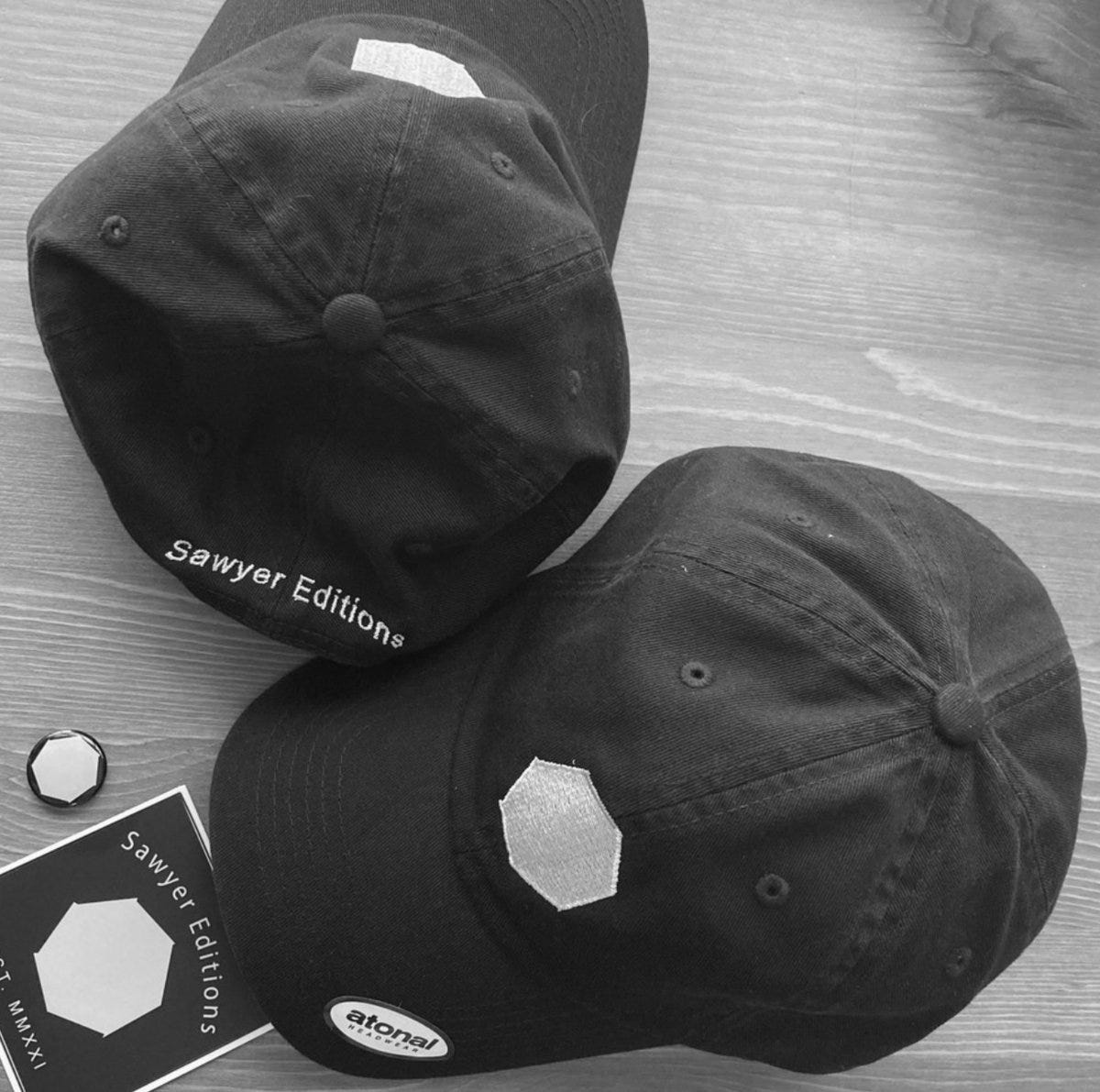
The next batch of Sawyer Spaces albums is on its way-- maybe a little bit later than I was hoping, but I’m not sure anybody other than me is actually keeping track of my release cycles, so as long as I’m keeping them balanced between Spring and Fall for Sawyer Spaces I’m not too concerned about it. Anyway, it’s a great batch of releases and one thing I’m particularly excited for as the fact that I’m moving away from doing CDR‘s. I’m so over burning CDs hand-folding things and going to FedEx and needing to order packaging and all the tedious shit comes from having to DIY manufacture every single release.
I’m really proud of the last six batches of Sawyer spaces releases. It’s been an absolute passion project and a real love of mine and some of the best music I’ve been involved with has been released on Sawyer Spaces. But the fact is: not a lot of people follow Sawyer Spaces and even less actually spend money on Sawyer Spaces releases. I’m not saying that to sell you something, and that’s not a pity-party-statement; it’s just a fact people don’t really buy physical media anyway, let alone for field recordings or anything like that--if you do like this stuff, please support it whether or not it Sawyer spaces but anybody’s label.
Still, I have to do the cost benefit analysis of the time-money-energy that it takes for me to do these releases and one thing that I had to cut in that calculus was me DIY-hand-making the releases and I am so, so happy for it. I love that old packaging. I will always love the old packaging, but the time has come for me to move past it. So, starting with the next batch of Sawyer spaces releases—which, hopefully will be out around the time the next entry of this Substack comes out--you’ll see new packaging that’s manufactured by somebody else. Perhaps that means Sawyer Space is loses a bit of its DIY quality and/or street-cred, a little bit of its cottage-industry quality, but maybe more folks will buy it if they can see the spines of the CDs on their shelves.
More than anything, the quality of the music is still pretty damn high: go listen to that shit.
The Part About Books
From the back over: “The ambitious goal of author Bryan Jones was to create a fresh understanding of the Nebraska Sand Hills from the inside.” It’s not fair to compare every non-fiction, literary travelogue and localized history that deeply examines a single, sparsely populated area to PrairyErth, but if you’ve experienced Heat-Moon’s deep map, that is the gold standard by which these “modern-day Walden” books will seemingly always draw comparison. North of the Platte, is not quite a deep map, but it does indeed go “a little further” (dare say “deeper”) into [deep] mapping the Nebraska Sand Hills. Often distracted, loose, and from an exceedingly Boomer-tastic vantagepoint. If you’re already familiar with Nebraska’s Sand Hills and are in love with them as much as I am, you’ll likely enjoy this enough to finish it. But if the region is new to you, it may not be the best choice.
The Nebraska Sandhills is one of the most mesmerizing landscapes in the world and one you’ll probably never be lucky enough to visit. They are the largest and best developed [vegetated] sand dunes in the Western Hemisphere and sit on top of the Ogallala Aquifer, taking up about as much room as West Virginia but with roughly 56,252 residents. This book doesn’t fully capture the land, history, culture, and people of the region but you may gain insight into that way of life. It might be surprising, but significant portion of the book focuses on Ted Turner, who owns 5 Nebraska Ranches and is the single largest landowner in the state: “Some people are ascribing all kinds of motives to Ted. That he’s going to control the water and therefore the rest of the state,” said Turner biographer Porter Bibb. “This guy is utterly unpredictable. He’s also a little bit bizarre.” All of this illustrating a common modern dilemma: family ranches passed down since Homestead Act days are now being sold either because younger generations aren’t willing or able to continue operating them and families struggle to decide their future or wealthy land barons and/or the Mormon Church (the other largest landowner in the State) price them out – this by the way is a topic that is criminally under-reported probably because it’s way less sexy than Boomer-dunking on Ted. These heavier themes are balanced with chapters covering a range of experiences, including a kayaking trip on the Dismal River, a visit to a small one-room schoolhouse that is still in use, an exploration of writer Mari Sandoz and her family, the author’s plane crash, a float trip down the Middle Loup River in a cattle tank, discussions of the region’s geological history, and an explanation of the Ogallala Aquifer, fleeting interviews. etc etc etc.
It’s fine, but a little too specific yet too loose for me to recommend to anyone not born in Nebraska’s 3rd District or otherwise not as interested in this stuff as I am.
I read this book. That is to say that my eyes looked at every word on every page and internalized the things being told to me by my subvocalization. There are themes, there is a plot, there are ideas being expressed in language that I understood to be of a literary artform. Why do I say this? Honestly, because many words have been spilled by others that give me the impression that I did not, in fact read Atilla by Aliocha Coll – if on a winter’s night a Kory.
First, this book was a gift by my friend Ernesto who frequently gifts me books that are translations from the Spanish: “why would I read it in English when I can read it in Spanish.” Fair enough. Thanks Ernesto! Anyway, when he gave me the book, he said “it’s a pretty wild book by a recluse in Paris.” That was at least a year ago – this one has been sitting on my shelf for some time: long enough that I don’t remember anything I read about it when I got it. But, it came with another book Atilla by Javier Serena, (collectively available as “The Attilas”), which I thought was a non-fiction account of the writing of Coll’s book, but it turns out it is a fictional account of the final days and writing of Coll.
Herein lies the twofold point: there is a weird amount of hagiography around this author, and there is a powerful aura around the book being difficult. Both of these I find interesting if not unsettling.
Last year, Federico Perelmuter said in a kind of lame article for the LA Review of Books “American’s can only accept foreign literature once they have washed it with superlatives. Nothing less than a disinfectant exaltation—“masterpiece!” “genius!”—will do if the book is to be read.” […] “Brodernism is not a writerly movement but a critical tendency, not a tradition in the strict sense but a kind of post facto absorption, a critical construction with no real basis in textual history or novelistic corpus that is slowly trickling into the fictional unconscious. An aesthetic product, often, of critical ignorance or disregard: glorious local and regional traditions of experimentality or ambition vanish under the haze of a homogenizing (and loudly proclaimed) American reception as “difficult.”
I’m inclined to agree with Reddit user u/ritualsequence here: “[Perelmuter] absolutely tried to do too much here, and the whole bro-lit portmanteau sucks, but there’s definitely something to the argument about why certain types of book get the marquee ‘Translated Literature of Significant Importance’ treatment, both in terms of how they’re published and how they’re received by critics.”
Aliocha Coll The pseudonym of Javier Coll Mata (Madrid, May 6, 1948–Paris, November 15, 1990), Aliocha Coll was a Spanish writer and translator raised in Barcelona who spent several years of his adult life in Paris, where he committed suicide after completing Attila. He is the subject of “Everything Bad Comes Back” by Javier Marías and believed in Finnegans Wake as the “starting point” for contemporary literature. In addition to Attila, he wrote a couple novels, a play, and several essays, but the majority his work was either published posthumously or remains unpublished, despite Spanish super-agent Carmen Balcells backing him throughout her life as the future of Spanish literature. It’s not Coll’s fault that this is the bio being used to sell his books but this bio contains information repeated again and again and again when reading about this book: this is the tortured artist trope, a trope that I find unsettling, toxic, and a distraction from the work itself. It is a pervasive archetype that I think does a disservice to the work, but it is highly productive at producing a captivating aura. Mental health is something that all artists navigate, and pain certainly can be and is expressed in a myriad of artistic forms. But it’s really hard to be creative when severely depressed, psychotic, or dead and while his biography is of course true, I don’t find it to be a particularly strong selling point. Or at least, I think it can be a rather cheap one to be repeated again and again. It sounds something like: “this book guy is crazy and nobody understood him and he killed himself after he finished his final unread masterpiece isn’t that cool???”
I’m not alone in this. Jon Repetti’s fantastic review of the book points out: “Serious effort is being made on both sides of the Atlantic to promote Coll not merely as an ‘unjustly neglected author’, or an ‘eccentric, hermetic writer’ — the stock role of the rediscovered 20th-century genius — but as the very paradigm of belatedness itself, of isolation itself: the writer with an audience of one.” As Andrei in The Untranslated wrote “Aliocha Coll represents that ideal of an uncompromising artist to which many authors aspire in their romantic fantasies, but very few dare to achieve.”
Indeed a legend is born.
So, what actually happens in the book? Just read the back:
“Attila the Hun, reimagined as a visionary leader, contemplates the fate of his people at the gates of Rome. His son, Quijote, is caught between empires and ideals, forced to choose between his father’s vision of a Hunnic utopia and the decaying allure of Roman civilization. As Rome burns, Quijote journeys through both real and surreal landscapes, encountering psychedelic visions, mystical revelations, and existential dilemmas.
Quijote’s journey blurs the lines between past and future, uniting Biblical, Classical, and Buddhist traditions while moving between planes of existence. Attila is an intricate and elusive masterpiece from the explosive and disorienting imagination of Aliocha Coll, where characters from myth and history intermingle in a stunning labyrinth of allegory and metaphor.”
This is all true; that’s what happens in this book. However, knowing the form does not take away from the experience of the content. Yet there is the second unsettling discussion I mentioned above: the difficulty.
Javier Serena (who has a vested interest in the hagiography, mind you) writes in the prologue:
“Have we read Aliocha Properly? Will future readers, more attuned to his work’s complexities, appreciate it in ways that elude us, despite our intuitive sense of its value? […] [N]avigating his work presents serious challenges: finding coherence in the discourse, deciphering the logic in each sentence, and following a narrative thread are formidable tasks in this meticulously crafted yet enigmatic novel. The prevailing response to Coll’s work has been one of perplexity. Critics, acknowledging his talent, education, and audacious approach to literature, find themselves caught in a paradox: they respect and recognize his rejection of literary convention,, his deep exploration of tradition, and his quest for innovation, they struggle to fully embrace books that resist interpretation and communication”
Indeed, translator Katie Whittemore’s [pretty weird] introduction describes how her psychic medium told her that this would be a “chaotic” process “you’re just going to have to interpret it.” In fact, she writes about having to use ChatGPT for ideas and help in the translation… I’ve never seen a translator say they didn’t like the book very much, at least “not in the way that we usually ‘like’ books.”
Much has been said elsewhere and is deeply implied by the hagiography that this is an exceedingly difficult book. In many ways it is challenging: the book is abstract, or at least it has a lot of abstractions. It’s surreal, there are tons of puns, metaphors, lyrical exegeses, dream-logic, a polyphony of voice, tons of historical references, and plenty of goodies that will keep the professors busy for centuries arguing over what he meant. But while having a cursory knowledge of Greek and Roman history and mythology was useful, please understand my Dear Reader, the book contains nothing but words to be read: it ain’t that hard.
This all reminds me of my stance on abstraction in my own work. A Thought grew out of my ongoing fascination with consciousness. The more I reflect on reading, writing, speaking, or thinking, the more I realize how passive these acts can become. We rarely notice them; the mind drifts while the brain’s mechanics take over. Thoughts appear uninvited, and we often aren’t fully in control, especially in charged moments like meeting a stranger or approaching a potential love interest, when fears and anticipations multiply. In A Thought, I wanted to stretch such a moment from the inside, turning a second into a scene and the mind and body into the drama’s central players.
While artist-in-residence at Arts Letter and Numbers, I explored how intrusive thoughts influence decisions and how nonsense words might gain meaning through structure. Inspired in part by Stockhausen’s lectures, I organized phonemes and syllables through matrices and formal processes, integrating vocal sounds into the pitch structure. The system worked musically but dramatically, it failed. The assembled text was essentially nonsense. In a workshop with Jennifer Cresswell and Jake Heggie, Jake gently reminded me that opera needs grounding (honestly, this whole workshop was one of the best lessons I ever got in storytelling).
I’m a huge fan of film, especially abstract movies and slow, art house cinema. I’m always down to get weird, and explore wild things, but I think the films, the operas, and the abstractions that I’m drawn to all benefit from having a single nugget of reality to latch on to. An example I’ve heard before is David Lynch’s “Eraser Head” (1977): it’s a movie about a guy who isn’t ready to be a dad. That is an emotional core to hold on to, and then from there we can explore all kinds of abstractions and really go off the rails (I think the same is true of “Inland Empire” (2006) perhaps even to a greater degree).
So, from here we can enjoy the book. Go back to the description from the back of the book: if you keep that description in your head, that’s all you need. You will experience so much even if you don’t get everything. There are deep themes here about history and how someone (an artist especially) situates themselves within it.
At its heart, the novel uses its reimagined Attila (not a conqueror but a philosophical dreamer) to explore big questions about identity, inheritance, and the allure of grand ideals. His son Quixote (who is actually the main character) is caught between two powerful visions of civilization: Rome’s orderly, legal empire and his father’s carefully planned steppe utopia. Both promise meaning and structure, but both demand that he fit into a ready-made design. Is real freedom is possible inside any total system? The story keeps returning to doubling, split selves, and cryptic messages, suggesting that identity is unstable and reality itself might have layers. Even the cave scene flips the idea from The Republic: instead of being trapped by illusion, the characters enter a space of strange insight, where visions blur the line between inner and outer worlds. Historical, biblical, and mythic figures drift in and out, making the whole narrative feel like a symbolic collage rather than straightforward history or story anyway. The novel widens its lens, comparing cultures and wondering what actually lasts. Moments of harmony are tinged with sadness: every perfect vision contains the seeds of destruction. Trying to engineer a flawless world might be more dangerous than simply living imperfectly within one.
Did I get everything? Fuck, no way. Still, I liked it. Going back to what I wrote about Miss MacIntosh last month: I had a valuable aesthetic experience that answered valuable questions both in and of the text.
It’s very difficult for me to assess this book outside of the context in which I discussed the other book called Attila above. Maybe if I read this book in isolation it would be a different feeling—although, I would still struggle with some pretty gross fetishizations of women-as-muse and I would still feel the same way about the hagiography and about the weird fetish of the suffering artist, which is, like, pretty much literally what this entire book is.
I can critique the prose and I can critique the writing, which is all there which is all fine and maybe I would’ve been interested in reading the fictionalized account of Roberto Bolaño, but considering how Attila and Attila are necessarily paired by the publisher, necessarily paired by the forward in the other book called Attila, necessarily paired just by their subject matter and the interpersonal relationships between the authors, it makes it very difficult to detach this book or see it in isolation at all.
I’m not sure I would’ve liked it anyway--if anything I might’ve just felt pretty meh-to-nothing about it, which maybe is worse than disliking it but it’s because of its bigger relationship to something that I find deeply problematic.
Maybe I had the yuck going into this from the beginning.
“Dust to Dust” – Lameese Badr
Another entry from the New-Generation African Poets: A Chapbook Box Set (Nane) continues to affirm the essential quality of this collection to any poetry shelf. In the preface, Samiya Bashir says his tight cycle is “deceptively innocuous in its simplicity” and I think that’s absolutely true. These poems are short, but they’re not brief. There is an ever present “you” that is always shifting: at times it is me, possibly literally, at times it is the indefinite you being talked to (or perhaps talked at): they call into the middle-distance in a compact elegiac tone that both shoots right into the mind while keeping you at a safe distance:
If that makes you a god
Or a distraction
(pg. 17)
Borders and personhood are permeable membranes:
It took a lifetime
Of running everywhere
And belonging nowhere
To know that I am not of this world
(pg. 11)
When my love reminds me
I will always remain an island
It becomes a political one
(pg 16)
Repetition is essential here and the cycle calls back certain phrases creating these connections across time and place:
There are many ways to leave besides leaving (pg. 13)
there are many ways to die besides dying (pg. 18)
I am too many women to hold (pg. 14)
I have too many women in me (pg. 20)
“Pure Hollywood” – Christine Schutt
The first re-read of the year. Every year, I try to set a little reading goal, often something vague and more vibes-based than anything, This year I have a few goals: 1) clear my to-be-read shelf 2) have the majority of my fiction reading be written by women 3) re-read things.
I am a terrible re-reader, and I can think of only one book I’ve re-read since I started keeping track of my reading and getting back into fiction in 2020 (a book I’ll re-read again this year because I still can’t remember anything about it). I’m not sure how this got stuck in my head, but as I’m writing this entry for this Substack I cannot find the source of a quote: “the best readers are re-readers.” Is it a Nabokov quote? Is it an Eco quote? I can’t find a source… anyway, contrived or not, this mantra has stuck in my brain.
Everyone has the problem of buying more books than they can read. For me, this is becoming a geometry problem in a two-bedroom apartment, so I am really trying my damndest to have read everything I own before piling up new shit. I’m also at a weird moment in my reading where I don’t really yearn for anything; there are no white whale books that I haven’t been able to find or that I’m really itching to read.
So, why not chip away at the to-be-read shelf, which now contains only books written by men, and alternate new books with one or two re-reads of books by women?
There it is.
Why this one first? Because it’s a short story collection and I’ve been reading some heavy-lit dense stuff recently. I actually came to this one through my friend Christopher Robinson who did Instagram Live readings during COVID (still does on occasion) and he read a few of these stories. I liked what I heard so I picked up a copy on AbeBooks; it ain’t that deep.
Still, I like this collection a lot! I liked it the first time and I think I liked it better this time! Looking through Goodreads, I feel like I’m in the minority opinion here with the book having a cool 2.98/5 based on 700 ratings.
Goodreads user Roxane says “These are a very specific kind of story—highly mannered, odd, witty. All about white people of a certain class. Nearly every story features a death and something about gardening. The title story is the strongest.” (3/5 stars) I agree! This is a very arcuate. I like the economy of means, the compact stories with the poetically lingering prose that is somehow distant and microscopically detailed.
User Felice Laverne and I find opposite conclusions about the same thing:
“The woman who had just been identified as attached to Dick Hedge looked pained by the clotted, green sound of her little boy’s breathing, an unwell honk that did not blend in with the sashaying plants and beachy-wet breeze of the island.
*raising hand* Umm, did you just try to say that a woman’s son was sick on the beach? I had to read that line at least three times just to extract some meaning from that sludge of words, almost senseless when mixed in that formula” (2/5 stars)
See, I like that shit. Call it erudite all you want, but that doesn’t mean you can’t get something out of it. The stories are these little vignettes: compact stories in, of, or around big topics like death. They are deeply evocative, even for some stories as short as 3 pages. The title piece is nonlinear and feels subtly stream of conscious: we don’t get a sense of when this takes place until the final paragraph reading: “out of the shed and into the just right night of Los Angeles in…? Let’s say it was May in the first decade of the hardly promising 21st-century” Impressionistic, we could be anywhere sometimes, just looking in.
There’s also a woman’s voice and perspective that is going criminally understated in any of the reviews I’m seeing. There are multiple stories about motherhood and how maybe, just maybe, there’s more to life than that and perhaps being a parent, specifically a mother or stepmother, kind of sucks.
From user Slow Reader: “students of the John Ashbery school of prose are incapable of writing bad stories even when they resemble plotless photographs of people whose ordinariness is uncannily real, and whose past (like those heroines of Salinger) only portends future misery.” (4/5 stars)
Not a feel-good book, but one I really enjoy
I was surprised by the--what I think is a--low rating on a book I’ve seen on a number of Bookstagram pages with glowing reviews. After reading it, I can see why it’s not for everyone, but I really liked it. An episodic slice of life that for some reason I read this as if it were a highly-stylized Wes Anderson movie with a start-studded cast of aged Hollywood actors; Frances McDormand plays Miss Morris (from Grand Island, Nebraska, no less); Robert De Nero is Mr. Thompson; George Clooney plays Tim Tellerton; and I’ll die on each of these hills.
Based of reviews and references to her other books which I haven’t read (yet), Jansson “continues her fascination” with the inner lives of the elderly, not by punching down but by showing them as complex people with desires, jealousies, humor, and grief. Inspired in part by her travels in the United States during the 1970s, she turns her attention to the distinctly American setting of the retirement community in St. Petersburg, Florida which becomes the stage for a loosely connected portrait of aging residents and the workers who orbit their routines in a collective portrait of life at the end of the road. Residents cling to memories, nurture petty rivalries, and improvise ways to pass the time, while employees bring their own stories into the orbit of the home, including an eccentric young man—played by a scurvy looking Kyle Gallner in my head-cannon-- awaiting Christ’s imminent return (another distinctly American theme).
The book feels exaggerated, with heightened incidents and characters that verge on caricature but her prose covers several emotional textures of aging, from the quiet fear of physical decline to the lingering need for conversation, recognition, and dignity. There is something of a meditation on time and the limits of understanding between people and you get a feeling that the residents sense there is too little future left to justify the effort for… a lot of stuff.
I laughed out loud, and really enjoyed it! Some might read this mini-review and say I’m giving it more than it’s worth… would I recommend it to everyone? Probably not, but if you love it, I totally get you.
“The Maybe Bird” - Jennifer Elise Foerster
What art
Should be assembled through such a scene—
Black creek, rusted pine
A people’s baggage
Thrown into their graves
(Pg 5)
Formally the book is something like a Klein bottle or a fractle. The book is in three parts, the first two take up 29 pages and the third takes up the remaining 100-ish pages. The third section, the title-section “The Maybe-Bird” is itself broken into 4 sections (numbered in Muskoke), the titles of the first section of “the maybe-bird” make up the complete first poem, so each poem in this section is a spiraling out of each line of the first poem. The second section’s titles make up the complete poem that concluded the first part.
Not written about halfway through: Inside of these poems, lines are shared verbatim across the whole cycle. There are more examples here than I could reasonably count without really, really getting into the weeds if it, but I’m sure they are every and marked several in my copy.
Note written after reading: okay, so the back Appendix A has choreography and charts for all the connections. All of this isn’t mere formalism either. While this does give a really interesting formal schema, it also produces a deep and experiential interweaving of each poem in a macro and micro sense. To me this is similar to how the first section, to quote the note: “repurposes language from the eight texts written by explorers or Indian agents to Creek County from 1527 to 1828. The process involved cutting erasing and rearranging language which resulted in a series of text quilts.” But, we get this in a bigger way and you can feel it as it’s happening. This thing is bad ass, y’all.
From another review: “At her book’s launch event at the Cambridge Public Library, Foerster described how she intended to “create a spiral sound,” combining fragments of language to resonate rather than narrate, where “meaning happens in convergence.”
The repetition here and throughout the book is never repetitive: it’s always resonant, echoing, changing and shifting meaning. There is a really fun play with syntax and extensive use of transferred epithets, a new vocabulary word for me. When an adjective is used to describe a noun it does not logically or typically modify, it is called a transferred epithet. In the study of rhetoric, this is also known as hypallage. Example: “barely audible northern moonlight” (pg 51)
Highly recommended; I will be studying this one.
The Part about Movies
I really wish I was a cinephile “movie guy” but I’m not sure I am capable of it. I love film and every year I tell myself “I will be watching more movies this year” and ya know what, I don’t know if I’ve ever accomplished that goal. I didn’t watch a single movie in February.
I’m not gonna use this space this month to wax poetic about the artform. I just don’t have time for that this go around. But looking at the heading for this entry and seeing that I have literally nothing to put here is a bit of a bummer and something I would definitely like to improve. I got my Criterion Channel subscription hoping it would motivate me to watch a little bit more but damn sometimes at the end of the day I just wanna unwind with some trash TV or go out and sometimes I’m just not in the headspace for a three-hour slow-burn (let alone some 2000s gross-out comedy.
So cheers to all the movies I didn’t watch into the Google doc of the more than 100 I intend to one day.
The Part About Racing
Well, we made it. The racing season is in full swing across all the various formats in series that I follow. I’m not going to use this platform as a place to wax-poetic about every single race that I watch and every opinion that I have about everything related to my favorite sport: but, maybe just when I have something to say or something that I think is interesting to talk about.
It’s a conversation for another time, but the intersectionality of my class-consciousness, capitalism, and global geopolitics in motorsport is an interesting one. I have read the Marxist-influenced critiques that all sport is a distraction to the proletariat against the capitalist structures that oppress us. On a fundamental level, I tend to agree with this: the amount of billionaire-tax-write-offs that get burdened by the tax-payer in order to build stadiums is tragic. The amount of money -- and admittedly environmental impact -- that goes into motor sport is tragic, and maybe this is something that I will reckon with one day and maybe this will be something that I do a further deconstruction on later.
For this month’s ramblings, I’m thinking about a statement that I’ve seen pop up across some [perhaps less woke] areas of my Internet life which is a mantra that I’m sure everybody has heard: “keep politics out of art” which in this context we can always rephrase to “keep politics out of sport.” Both of these statements are laughable at best and at their worst they open the door to fascism.
The ongoing and criminal war that Israel and the United States is waging against Iran will have long reaching and dark consequences. I am not trying to draw false-equivalencies to that, but in a Reddit thread about the Formula One races in the Middle East getting cancelled (which they surely will be) somebody said: “I just wish politics could stay out of my sports.”
It’s not every day you wake up to read the dumbest shit you’re ever going to read in your entire life - or maybe it is every day in 2026? - but this one stuck with me in a very strange way. On the one hand the gross conflation between loss of life and entertainment is absolutely asinine, but any assumption that a cultural object --be it a painting or a piece of music or a sport-- is in some way outside of the influence of politics on not only local levels but large, geopolitical levels is some of the most batshit ass-backwards way thinking I’ve seen in a long time.
Brother, it’s all politics and to say it’s not, well… that’s politics too.
More to be said at a later date.
Conclusion Corner
This comes out March 13th and I leave for tour March 17th which means (unless I get really inspired) the next one will be entirely written from the road. Will anything change? Who knows: tune in to find out.